

Building a top-performing sales team isn’t just tactical—it’s strategic. Sourcing, evaluating, and onboarding top SaaS sales talent can make or break your growth trajectory. Here’s a guide that mirrors proven best practices, tailored for SaaS startups.
Key Takeaways
- Define your hiring needs early: Choose between in-house, outsourced (agency/contractors), or hybrid models.
- Understand the true cost and ROI: Talent, training, and tech stack costs compound quickly.
- Scale strategically: Build a flexible team that grows with demand.
- Focus on skills + culture: Persistence, empathy, SaaS product understanding, and alignment matter.
- Structured hiring process: Define roles, source candidates, interview rigorously, and use data-driven metrics.
1. Why Hiring the Right SaaS Sales Talent Matters
Salespeople are the engine of recurring revenue. A top SaaS sales rep can accelerate pipeline velocity, improve churn metrics, and compound growth. Conversely, the wrong hire can waste budget, derail momentum, and damage brand reputation. Remember sales hires need precision.
In‑House vs. Outsourced vs. Hybrid Sales Teams
In‑House Team
- Pros: Deep product immersion, consistent cultural fit, strong control over messaging and feedback loops.
- Consider When: Your product requires long sales cycles, deep technical demos, or regulatory knowledge.
Outsourced Sales (Agency/Contractor)
- Pros: Fast ramping, specialized skillsets (e.g., lead generation, account management), reduced overhead.
- Drawbacks: Less control, potential misalignment in messaging, reduced ownership. Ideal when experimenting with new market segments.
Hybrid Model
- Combine: core in-house team + niche agency/contractors for overflow or specialized roles.
Tip: For most SaaS startups, a small in-house team (1–3 reps) supported by contract SDRs or lead gen agencies provides flexibility and speed.
Calculate Your True Cost of Hiring
- Hiring & Onboarding Costs: Between sourcing, assessments, ramping—expect 3–6 months to hit full productivity.
- Tech Stack & Training: CRMs, dialing tools, sales enablement, external training, certifications—all add recurring costs.
Pro Tip: Track cost per rep vs. average sales booked to benchmark ROI before scaling.
4. Define & Prioritize Sales Roles
Effective hiring starts with clarity:
- Define core roles: SDRs (lead qualification), AEs (deal closing), CSMs (post-sale expansion).
- Match stage of startup: Pre–Series A often needs SDR + AE, while Series A+ may add CSMs, Sales Engineers, or RevOps.
Sourcing Qualified SaaS Sales Talent
Just like choosing right headhunter can help you avoid any wrong hires. Check out our testimonials from clients where we helped them hire top sales talent crushing the quota numbers.
a diversified sourcing strategy works best:
- Network & referrals: Warm leads can reduce cost and speed hiring.
- Freelance & specialized platforms: Upwork, SalesX, CloserIQ offer vetted reps for contract/part-time roles.
- Recruiters & agencies: Ideal for hard-to-fill roles or new regions.
- Job boards: SaaS-specific boards like SaaS Sales Jobs, AngelList.
- LinkedIn and outreach: Passive candidates who know your target market.
Important: Track channel effectiveness—cost, quality, time to offer—to optimize sourcing mix.
6. Interviewing & Assessing Candidates
Ongoing performance metrics matter—as much for hiring as onboarding.
- Screen on core competencies:
- SaaS product knowledge
- Experience with demoing, handling objections
- Metrics-driven mindset (e.g., quotas, KPIs)
- Behaviors to assess:
- Resilience under rejection
- Communication + active listening
- Coachability & self‑improvement habits
- Sales exercises:
- Mock cold calls
- Objection handling roundtable
- Simple role-plays (up-selling a higher tier, dealing with tough stakeholder)
- Reference & background checks:
- Confirm quota attainment
- Ask about onboarding and ramping pace
Hiring Models & Engagement Options
- Full-Time Salaried + Commission: Best for core team and sustainability.
- Contract SDRs: Ideal for flexible volume surge.
- Agency or Fractional AEs: Good for short-term objectives or market testing.
- Hybrid: Use FTE for strategic roles and contractors for scalable outreach or overflow.
Onboarding & Ramp Strategy
- Week 1–2: Deep dive into product, ICP, positioning, competitor analysis.
- Week 3–6: Side-by-side shadowing, light role playing.
- Month 2–3: Manage own pipeline with co-published deals.
- Month 4+: Fully quota-bearing.
Enablement, Tools & Continuous Learning
- CRM hygiene
- Ops cadence
- Promotion testing & optimization
Tools:
- CRM (HubSpot, Salesforce)
- Dialers (Aircall, Outreach)
- Analytics (Gong, Clari)
- Training (Brainshark, Lessonly)
Metrics & Feedback:
- Weekly pipeline reviews
- Ensemble learning
- Monthly scorecards with objective KPIs
Scaling Strategically
- Match headcount to pipeline: If rep generates 100 qualified leads/month, hire SDRs in groups that sustain multiple AEs.
- Geo & market expansion: Use flexible engagement (contractors, agencies) when exploring new verticals or regions.
- Balance core vs. variable cost: Consider salary/commission ratio, agency cost-per-meeting, contract incentives.
Common Missteps to Avoid
- Rushing hires → misalignment on skills and quotas.
- Ignoring fit/culture → poor retention.
- Lack of structure/tools → lack of accountability and tracking.
- Over-dependence on one model → agency reliance can dilute brand.
- Under-investing in enablement → poor ramp and churn.
Fix: Audit your process regularly—time-to-ramp, win rates, rep retention—and iterate.
12. Final Thoughts
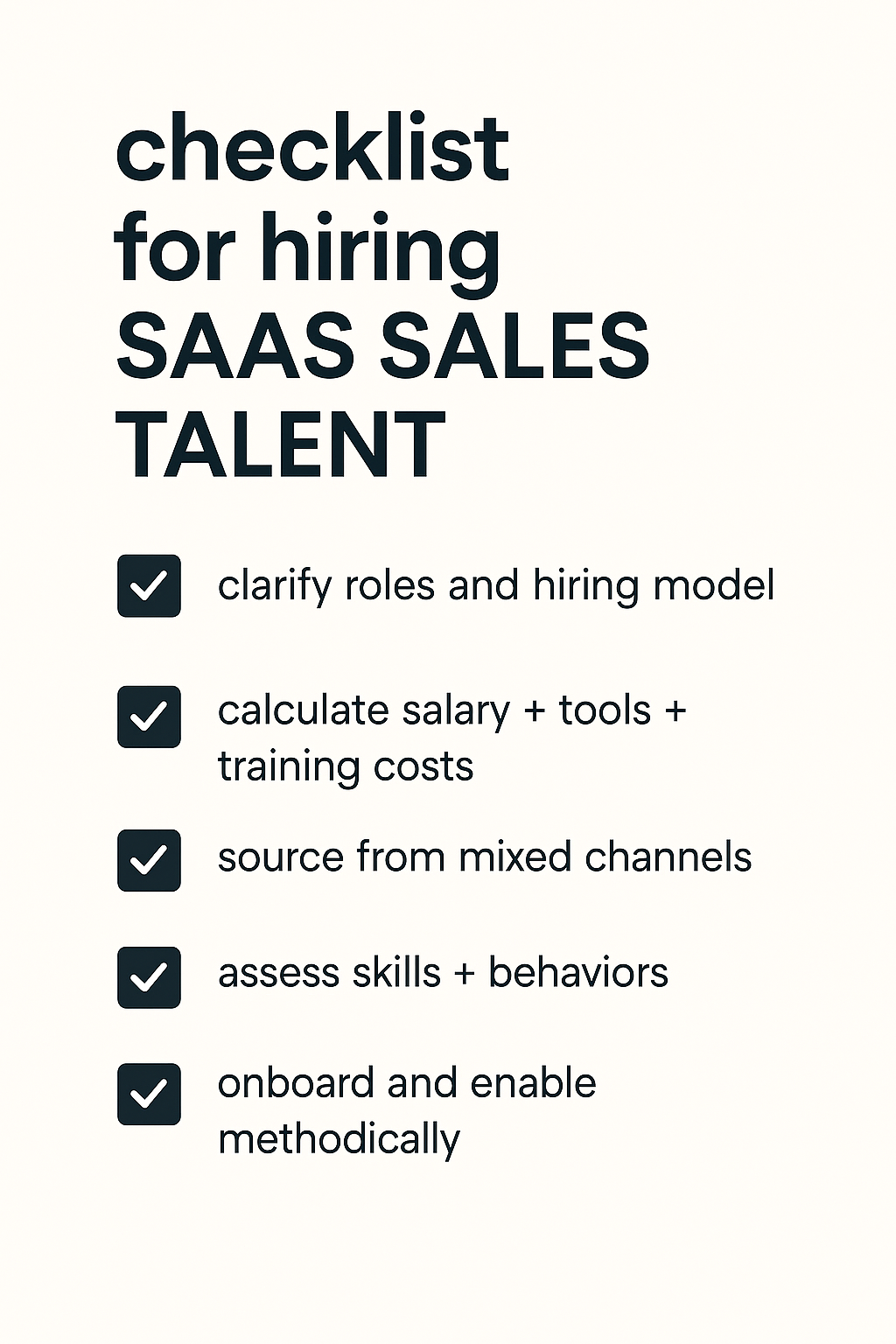
- Define roles & model (in-house, outsourced, hybrid)
- Budget and cost analysis (salary + commission + tools)
- Source wisely (referrals, platforms, agencies)
- Assess rigorously (behaviors, mock calls, references)
- Onboard methodically (shadowing → independent pipeline)
- Implement enablement systems (tools, metrics, coaching)
- Scale smartly (processes, roles, regions)
- Refine continuously (audit metrics, solicit feedback, optimize cadence)
Get this right, and you’ll build a powerhouse sales engine that fuels sustained growth.
- Choose the right team model based on resources and product complexity.
- Calculate total cost per rep inclusive of salary, tools, training, and ramp time.
- Use data-driven sourcing and interview frameworks to find high-performers.
- Onboard, enable, and scale like a mini revenue operations engine.
- Use continuous metrics to detect missteps early and iterate.
Building a great SaaS sales team is like building a strong tech foundation — structure, clarity, tools, and talent alignment make all the difference. With Skillpad, you’ll be equipped to shape and scale a motivated, high-performing team.